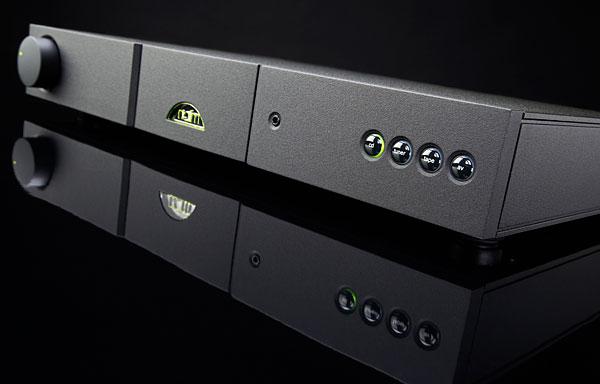
Naim Audio NAIT 5si integrated amplifier
Some among us remember a time when audio was divided into rival interests. On the left side of the pond was the New World, where left-brainers believed that vanishing harmonic distortion meant that "all amplifiers sound the same," and that good loudspeakers are a high-fidelity audio system's most important components. Across the waves, so-called flat-earthers claimed that the most important part of the playback chain was the turntable. (Of secondary importance were the tonearm and cartridge, followed by the preamp and amplifier. Loudspeakers were deemed relatively unimportant.) In the 1980s, this extremist idea of the "front end first" captured the imaginations of audiophiles, mostly in the Mother Country. Not surprisingly, it was first propounded by turntable maker Ivor Tiefenbrun, a vociferous Scot and founder of Linn Products. Flat-earthers believed that musical enjoyment was most directly related to a system's ability to preserve and convey what Tiefenbrun called pace, rhythm, and timing. Proper timbre was rarely mentioned.
Being anti-imperialist, I was never a flat-earther, but neither was I a left-brainer. I continue to be fascinated by and sympathetic to the original Linn/Naim worldview. Tiefenbrun and Julian Vereker, founder of Naim Audio, taught me a lot about how to listen and what to listen for when evaluating the effects of audio gear on the reproduction of music. I picked up a few additional dissident ideas reading British rags like Hi-Fi Answers, HiFi for Pleasure, and The Flat Response, an obscure zine founded by Chris Frankland, who operated in stark (raving) contrast to such popular New World publications as Stereo Review, High Fidelity, and Audio, all now defunct.
Long after he folded his magazine, Frankland declared, "I decided that The Flat Response would not pull its punches and that it would be a no-holds-barred, no-nonsense breath of fresh air in a market where its competitors were staid, unreadable and unfathomable to anybody who was into music. They talked of treble, midrange, bass, imagery and colouration—terms that meant nothing to anybody and failed to convey a sense of the musical experience that a good hi-fi system should deliver."
In similar spirit, Naim Audio became one of the first manufacturers to abandon the late Peter Walker's classic definition of the perfect amplifier being a "straight wire with gain," as well as the mad race for power and vanishing amounts of total harmonic distortion. In 1983, after 10 years of building only separate components, Naim introduced its first integrated amplifier, the NAIT (footnote 1). Believing that the character and quality of an amplifier's power supply are more crucial to good sound than its power rating, Naim refused to publish a power specification for the NAIT. (When I heard that, I went up to my New York City roof, faced northeast, smiled broadly, and applauded.) Vereker's views about the importance of power supplies, the virtues of low power, star grounding, keeping things simple, and fully attending to engineering details had a huge impact on my own humble attempts at amplifier design. (I continue to believe that the design of an amplifier's power supply is the factor that most influences how it drives loudspeakers and, ultimately, is most useful in predicting how an amp will sound when installed in an audio system.)
I have never owned a Naim anything, but now I wish I owned an original chrome-bumper NAIT so that I could compare it with the new NAIT 5si. My best memories of the original's sound were "a bit dry and spicy, with a good dose of juniper" (like working-class gin), and highly corporeal, with inescapable boogie factor. But, unlike some premium gins, which can generate a euphoric, almost psychedelic high, the original NAIT sounded a bit flat and colorless. I therefore wondered: Did the Naim engineers find a way to squeeze some extra (hopefully, organic) juniper into their latest audio distillation?
What is this NAIT?
In 2013, to celebrate the company's 40th year and the original NAIT's 30th birthday, Naim Audio introduced three new NAITs: the 5si, for $1895 (in Naimspeak, i stands for introductory); the XS 2; and the Classic SuperNAIT 2. The NAIT 5si is a traditional line-level integrated amp with a discrete headphone amplifier, but has no phono stage, no DAC, and no Bluetooth capability.
In 2013, to celebrate the company's 40th year and the original NAIT's 30th birthday, Naim Audio introduced three new NAITs: the 5si, for $1895 (in Naimspeak, i stands for introductory); the XS 2; and the Classic SuperNAIT 2. The NAIT 5si is a traditional line-level integrated amp with a discrete headphone amplifier, but has no phono stage, no DAC, and no Bluetooth capability.
The NAIT 5si's front panel looks strong and handsome, in a thoroughbred sort of way. The volume control is pleasurably stable and assured in its motion. The headphone socket and four source-selection buttons feel quite deluxe. On the rear panel is the power switch, along with heavy-duty speaker posts, four pairs of RCA jacks, and two DIN sockets wired in parallel with the CD and tuner RCAs. The first page of the owner's manual states, "DIN interconnect sockets should be used in preference to RCA Phono sockets," and "Naim Hi-Line interconnect cable will provide the best results." During the course of this review I used Naim DIN-terminated H-Line interconnects provided by Naim's US distributor, Audio Plus Services, as well as RCA-terminated varieties from Kimber Kable and Auditorium 23.
What happened first?
As I unpacked the Naim NAIT 5si, my buzzer rang. It was my recording-engineer friend Christopher coming by to play his latest project for me. "What's that?" he asked. I told him it was the new Naim NAIT.
As I unpacked the Naim NAIT 5si, my buzzer rang. It was my recording-engineer friend Christopher coming by to play his latest project for me. "What's that?" he asked. I told him it was the new Naim NAIT.
Chris sat, looking serious, as I dug through the pile for a record to play. I'd just bought a good bunch of 45rpm singles for $1 each, and I put on the J. Geils Band's "Looking for a Love" (Atlantic 45-2844). In about two seconds, all seriousness had vanished. "Somebody help me . . . looking here and there, searching everywhere . . ." Fist pumping turned into laughing and grinning. As I raised the tonearm, Chris started mumbling: "I've heard some bass in my time—but not like this. It's not big and it's not small. It's not even tight or loose. It's just . . . normal." I was using an Ortofon 2M Black cartridge and DeVore Fidelity's Orangutan O/93 speakers. Only thing I noticed was that the new NAIT showcased full-tilt boogie just as the original had.
I was also struck by how dissimilar this integrated amp sounded from the several others I'd been listening to. Lately, every time I switch amps, I think, How could any sentient being ever have thought that all amplifiers sound the same? In the last three weeks I've had four different, currently available, similarly priced integrateds in my system. Each played music in a fashion radically different from the others.
Listening
Miles Davis is always my go-to man for art and spirit—he makes good music to paint and think by. And because I listen to him so much, his music is also one of my favorite starting places for auditioning unfamiliar audio gear. I put on In a Silent Way (LP, Columbia CS 9875) and leaned back on the couch. This music is about harmonic energy arriving, establishing itself, and moving on. It played perfectly into my current obsession with rhythm. I define rhythm as the relationship between the length (in time) of one note relative to the following and preceding notes. So lately, when listening to music, I try extra hard to notice and appreciate rhythms. In his "Shhh/Peaceful," Davis uses simple, finely textured rhythms to develop long thematic lines that bob and swerve and effortlessly morph, one into another. The NAIT 5si powering my DeVore O/93s made it easy to hear—watch—these rhythms.
Miles Davis is always my go-to man for art and spirit—he makes good music to paint and think by. And because I listen to him so much, his music is also one of my favorite starting places for auditioning unfamiliar audio gear. I put on In a Silent Way (LP, Columbia CS 9875) and leaned back on the couch. This music is about harmonic energy arriving, establishing itself, and moving on. It played perfectly into my current obsession with rhythm. I define rhythm as the relationship between the length (in time) of one note relative to the following and preceding notes. So lately, when listening to music, I try extra hard to notice and appreciate rhythms. In his "Shhh/Peaceful," Davis uses simple, finely textured rhythms to develop long thematic lines that bob and swerve and effortlessly morph, one into another. The NAIT 5si powering my DeVore O/93s made it easy to hear—watch—these rhythms.
Read more at https://www.stereophile.com/content/naim-audio-nait-5si-integrated-amplifier#1eo6G4UEa3POzbZQ.99
